
Post
Ultimate Guide to Fast Spin Bearing Toy: Everything You Need to Know
May
I. The Evolution of the Fidget Tool: From Playground Fad to Essential Focus Aid
The history of the fidget spinner is often misunderstood as a fleeting viral trend from 2017. However, for those in the fields of occupational therapy and mechanical engineering, the spinner represents a sophisticated response to a biological need. The human brain is not designed for the static, sedentary nature of the modern workplace or classroom. We are creatures of movement, and when our physical bodies are forced into stillness, our cognitive focus often pays the price.
The “Basic Spinner” category has evolved from simple plastic trinkets into highly specialized tools. Today, we categorize these tools into four distinct pillars: the Child-Centric (Cartoon), the Traveler (Lightweight), the Everyday Carry (Pocket), and the Performance (Fast Spin). Each model serves a specific neurological and practical purpose, providing a tactile anchor for a world that is increasingly digital and intangible. To understand why these devices have moved from the toy box to the office desk, we must examine the physics of torque and the psychology of sensory integration that drives their design.
II. The Cartoon Kids Spinner: Engineering for Developmental Growth
For a child, a fidget tool must be more than functional; it must be approachable. The Cartoon Kids Spinner Toy is a masterclass in kid-centric design, balancing the physics of rotation with the psychology of character attachment.
The Material Science of Safety
When manufacturing for children, the primary constraint is the material. We utilize high-impact virgin ABS plastic, a polymer renowned for its durability and non-toxicity. Unlike recycled plastics, virgin ABS is free from the heavy metal contaminants often found in lower-end imports. This material is also “shatter-proof,” ensuring that even if a child drops the spinner on a concrete playground, it will not produce sharp shards.
Furthermore, the structural integrity of the Cartoon Kids Spinner is built around a permanent center cap system. In standard spinners, caps can be pried off, exposing the bearing and its internal steel balls, which represent a significant choking hazard. Our pediatric models utilize a hydraulic press-fit system that makes the cap inseparable from the frame, meeting and exceeding global safety standards such as ASTM F963.
Psychological Anchoring through Character Design
Child psychologists have long noted that children respond more effectively to tools that feel like “friends” rather than “medical devices.” By integrating smiling dinosaurs, superheroes, and animals, the Cartoon Spinner provides a “Visual Anchor.” During a sensory meltdown or a moment of high anxiety, a child can focus on the rotating character. The high-contrast colors create a stroboscopic effect that calms the visual cortex, allowing the child to self-regulate their emotions without adult intervention. This process, known as “external regulation,” is a key step in helping neurodivergent children manage overwhelming environments.
III. The Lightweight Travel Spinner: The Science of Discretion and Portability
For the modern traveler, every gram of luggage weight represents a cost in energy and mobility. The Lightweight Travel Spinner was engineered to solve the problem of “dead time”—those hours spent in airports, train stations, and bus terminals where restlessness is at its peak.
Achieving the 15-Gram Threshold
To create a spinner that weighs less than a standard house key, our engineers utilized a hollow-core geometry. In the world of physics, rotational inertia is dictated by the distribution of mass. By removing material from the center of the arms and focusing the minimal remaining mass on the outer edges, we maintain a respectable spin time of 45-75 seconds while keeping the total weight under 15 grams. This makes it the most “portable” focus tool in existence, fitting into a carry-on pouch or a passport holder without adding any noticeable bulk.
Acoustic Engineering for Stealth Use
The primary barrier to using a spinner on a quiet airplane or in a library is the noise. Traditional bearings produce a metallic “whir” that can be disruptive to others. The Travel Spinner utilizes a “shielded-track” bearing system. By encasing the steel balls in a synthetic lubricant and a vibration-dampening housing, we have reduced the decibel output to near-zero. You can spin this device in the seat next to a sleeping passenger, and the sound will be absorbed by the ambient noise of the cabin, providing you with a private, silent focus experience.
IV. The Portable Pocket Spinner: The Gold Standard of Everyday Carry (EDC)
The “Everyday Carry” community values tools that are rugged, compact, and reliable. The Portable Pocket Spinner is designed for the professional who needs a stress-relief tool that can survive the rigors of a pocket alongside keys, coins, and smartphones without being bulky or obstructive.
Ergonomic Scaling: The 4cm Standard
Most spinners are too wide for comfortable pocket carry, leading to awkward bulging in trousers or suit pockets. The Pocket Spinner is scaled down to a precise 4cm diameter, the optimal size for “fifth pocket” carry. It features rounded, polished edges to prevent snagging on fabric. Whether you choose the ultra-light plastic version or the premium anodized aluminum model, the tool is designed to be pulled out and spun in a single, fluid motion, making it an invisible part of your daily utility kit.
Tactile Feedback and Professional Discretion
In a corporate boardroom, clicking a pen or tapping a table is often seen as a sign of nervousness or lack of discipline. The Pocket Spinner provides a silent alternative. The aluminum version, in particular, offers a “premium” tactile feedback—a subtle, high-frequency vibration that lets the user know the device is working without creating a visual distraction for colleagues. It allows for “fidgeting in place,” where the movement is contained within the palm of the hand, providing the user with sensory grounding while maintaining a professional appearance.
V. The Fast Spin Bearing Toy: Pushing the Limits of Physics
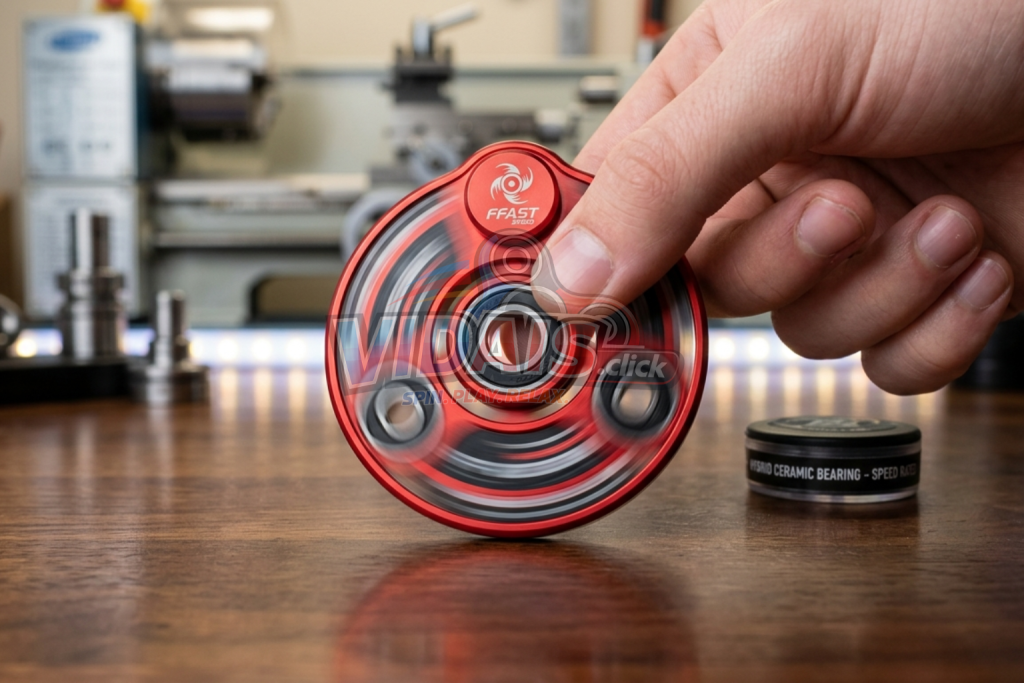
For some, a one-minute spin is not enough. The Fast Spin Bearing Toy is designed for the “performance enthusiast”—the user who wants to explore the upper limits of centrifugal force, torque, and gyroscopic stability.
High-Speed Hybrid Bearings
The secret to the 4-minute spin time lies in the bearing quality. We utilize a hybrid stainless steel bearing that is polished to a sub-micron level of smoothness. This reduces the “starting torque” required to get the spinner moving and minimizes the “rolling resistance” that eventually brings it to a stop. When you flick the Fast Spin model, the rotation is so smooth that the device appears to be standing still—a phenomenon known as the wagon-wheel effect, which is a testament to its perfect mechanical balance and lack of vibration.
Metallic Mass and Momentum
To sustain a 4-minute spin, mass is required. This model is constructed from solid brass, stainless steel, or aeronautical-grade aluminum. The heavier weight of the brass and steel models acts as a “flywheel,” storing the kinetic energy from your flick and releasing it slowly over several minutes. This makes it the ideal tool for practicing “aerial transfers” and “finger-juggling” tricks that require the device to keep spinning even after the physical impact of a catch.
VI. The Neurobiology of Tactile Engagement
Why do these tools work? The answer lies in the concept of Proprioception. Our brains need constant feedback from our joints and muscles to understand where our body is in space. When we sit still for too long, our proprioceptive system becomes starved for input. This leads to “restless leg syndrome,” nail-biting, and a general decrease in attention span as the brain searches for stimulation.
By providing a controlled, repetitive tactile input, these spinners “satisfy” the proprioceptive system. This lowers the level of cortisol (the stress hormone) and increases the production of dopamine and norepinephrine, the neurotransmitters responsible for focus and emotional regulation. For the student with ADHD or the professional with high-functioning anxiety, a $4 spinner can be more effective than hours of traditional “focus training” because it works with the brain’s natural need for movement rather than against it.
VII. Industrial Manufacturing Standards and Maintenance
We believe that a tool should last for years, not weeks. Every spinner in our collection is designed with a “closed-bearing” or “shielded-bearing” system. This prevents the accumulation of pocket lint, dust, and moisture that usually ruins cheaper, exposed-bearing spinners.
Cleaning and Long-Term Care
For the plastic models, a simple wipe with a damp cloth is sufficient. For the metallic Fast Spin and Pocket models, we recommend a blast of compressed air once a month to clear any micro-debris from the bearing housing. Because we use high-quality materials like stainless steel and anodized aluminum, the colors will not fade, the plastic will not yellow, and the metal will not rust under normal usage conditions. This ensures that the spin quality you experience on day one is the same quality you experience on day one thousand.
VIII. Pricing and Accessibility: Focus for All
We have optimized our global supply chain to ensure these tools remain affordable. We believe that the ability to focus and manage stress is a right, not a luxury. By focusing on “Basic Spinner” designs that prioritize mechanical quality over unnecessary “flashy” features, we can offer professional-grade equipment at a fraction of the cost of “luxury” fidget brands.
Cartoon Kids Spinner: ~~$6.99~~ $3.99
Lightweight Travel Spinner: ~~$6.49~~ $3.79
Portable Pocket Spinner: ~~$6.49~~ $3.79
Fast Spin Bearing Toy: ~~$7.99~~ $4.49
Conclusion: Reclaiming Your Concentration
The modern world is designed to fragment our attention. Whether you are a child learning to navigate the social pressures of the classroom, a traveler enduring a grueling layover, or a professional managing a high-stakes project, the “Basic Spinner” series offers a simple, effective, and analog way to reclaim your focus. By understanding the physics and psychology behind these devices, we can stop seeing them as toys and start seeing them as the essential cognitive tools they are. Choose the model that fits your journey, and discover how a small, perfectly balanced rotation can change your entire day.
